
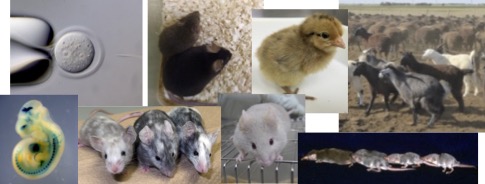
CRISPR/Casによるゲノム編集やTol2トランスポゾンを利用し、マウスを用いて高効率な遺伝子改変技術の開発と応用を進めています。 初代で表現型解析を可能にする遺伝子ノックアウト(Triple CRISPR)に加え、目的とするDNA配列を正確に導入するノックイン、条件付き遺伝子改変、大規模なゲノム領域の改変など、さまざまな遺伝子操作に取り組んでいます。 また、Tol2トランスポゾンを用いた高効率トランスジェネシスを開発し、エンハンサー活性の解析や組織特異的遺伝子発現の可視化に応用してきました。またこの方法は非常に効率よくバイオセンサーを個体に発現できる優れた方法です。 現在私たちは、これらの技術を単なる遺伝子改変手法としてではなく、発生・進化の仮説を個体レベルで直接検証するための実験基盤として活用しています。
2.シス制御因子から「進化をつくる」~形態進化の実験的再構成~動物の形態は進化の過程で大きく変化してきましたが、発生を担う遺伝子そのものは脊椎動物の間で驚くほどよく保存されています。私たちは、形態進化の重要な原動力が、遺伝子を「いつ、どこで、どの程度働かせるか」を決めるシス制御因子、特にエンハンサーの変化にあると考えています。 顎・顔面形成に関わるDlx遺伝子群や、筋肉・腱・骨格形成に関わるMyostatin、Scxなどを対象に、発生過程で働くエンハンサーを同定し、その機能と進化を解析しています。 さらにゲノム編集を用いて、エンハンサーを欠失させるだけでなく、異なる遺伝子座へ移植したり、新しいエンハンサーと遺伝子の組み合わせを人工的につくったりすることで、遺伝子発現や形態がどのように変化するのかをマウス個体で検証しています。 私たちが目指しているのは、自然界で起こった進化を後から読み解くだけではありません。進化の過程で起こり得たシス制御配列の変化をゲノム上に再現し、「進化を人工的につくって確かめる」ことによって、形態進化の原理を実験的に明らかにすることです。 このアプローチを、顎や筋骨格系をはじめとする脊椎動物の形態形成研究から、新しい発生工学へと発展させることを目指しています。
隅山 健太Researchmap https://researchmap.jp/read0199852
ORCID orcid.org/0000-0001-8785-5439
Google Scholar https://scholar.google.com/citations?user=qP9CIeIAAAAJ&hl=ja
----------------------------------------
1. Development and Application of Genome Editing and Transgenesis Technologies
We develop and apply highly efficient genetic engineering technologies in mice using CRISPR/Cas genome editing and the Tol2 transposon system.
Our approaches include gene knockout methods that enable phenotypic analysis directly in founder (F0) animals, such as Triple CRISPR, as well as precise knock-in of desired DNA sequences, conditional genome modification, and large-scale genomic engineering.
We have also developed highly efficient transgenesis methods based on the Tol2 transposon system and applied them to enhancer analysis and visualization of tissue-specific gene expression. This system is also a powerful approach for efficiently expressing genetically encoded biosensors in living animals.
We now use these technologies not simply as tools for genome manipulation, but as an experimental platform for directly testing hypotheses in developmental and evolutionary biology at the whole-animal level.
Animal morphology has undergone remarkable diversification during evolution, whereas many of the genes that control development are surprisingly well conserved among vertebrates. We hypothesize that one of the major driving forces of morphological evolution lies in changes to cis-regulatory elements, particularly enhancers, which determine when, where, and to what extent genes are expressed.
We study developmental enhancers associated with Dlx genes involved in craniofacial and jaw development, as well as Myostatin and Scx, which contribute to the development of muscles, tendons, and the musculoskeletal system. Our goal is to identify these enhancers and understand both their developmental functions and evolutionary history.
Using genome editing, we not only delete enhancers but also relocate them to different genomic loci and artificially create novel combinations of enhancers and target genes. We then examine how such changes alter gene expression and morphology in mice.
Our aim is not simply to reconstruct evolutionary history from existing organisms and genomes. Instead, we experimentally recreate cis-regulatory changes that could have occurred during evolution and test their consequences in vivo. By reconstructing evolutionary processes experimentally,we seek to uncover the principles by which changes in gene regulation generate morphological diversity.
Ultimately, we aim to extend this approach from studies of vertebrate craniofacial and musculoskeletal evolution toward new forms of developmental engineering.
Researchmap https://researchmap.jp/read0199852
ORCID orcid.org/0000-0001-8785-5439
Google Scholar https://scholar.google.com/citations?user=qP9CIeIAAAAJ&hl=ja